|
– KLEEBERG –
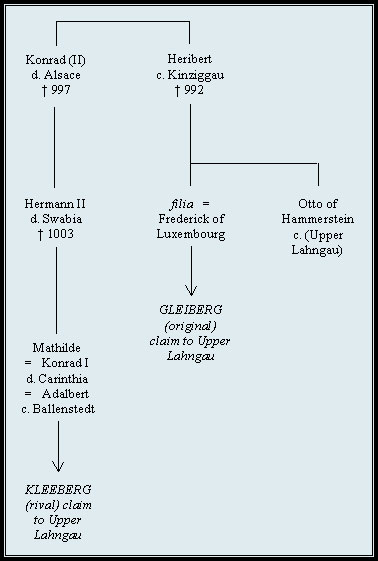
The county of Kleeberg was a fragment of the Gleiberg county and came into being as a result of the imperial schism and the virtually identical claims of Henry of Laach and Hermann of Salm especially with regard to jurisdiction in the pagus of Upper Lahngau. Henry of Laach must have been able to preserve some conquests there, but he was childless, meaning that after he died these conquests would inevitably pass to the sons of Hermann of Salm, from whom he had justifiably taken them. It was evidently in order to avoid this consequence that he adopted his stepson Siegfried of Ballenstedt. To preserve the conquests it was also necessary to reconstrue rights to Upper Lahngau. Siegfried descended from the senior Konradiner line via Mathilde, Duke Hermann II of Swabia’s daughter. And since he descended only from Mathilde’s third marriage, he was married to Gertrud of Northeim, Henry’s cousin, through whom the palatinate could also pass. Like Henry, Gertrud descended from Mathilde’s first marriage. Descent from the Konradiner via Luxembourg – the means by which Henry of Laach had claimed jurisdiction in Upper Lahngau – was no longer operative. There was a modest expansion of the concept whereby rights to Gleiberg ran not exclusively from Otto of Hammerstein and his sisters, but also from their first cousins. Presumably the arrangement was thoroughly legitimate.
Thus Kleeberg became Siegfried’s county and passed to his descendants, while the rest of the Gleiberg county was returned to its original holders. That Kleeberg was conceptualized as a county, a true judicial fragment and not simply an immunity, is suggested by its incorporation of the fourth part of the court of Hüttenberg. This court was located on an open rise, as was often the case with the public mallum, and it survived into early modern times as a hundred court. Moreover, it was held of the empire. Its proceeds were divided between the Gleiberg and Kleeberg counts, hence there is no reason to doubt that it was the original seat of justice in Upper Lahngau. In the county of Kleeberg, Siegfried († 1113) was succeeded by his sons Siegfried II († 1124) and Count Palatine William († 1140). The county then passed to the Bavarian count Konrad of Peilstein, husband of their sister Adela. His line, which also used the cognomen of Mörle, became extinct with the death of Count Frederick between 1214 and 1218. The principal heir was Henry I of Isenburg-Grenzau, and the castle of Kleeberg was held in condominium by several of his descendant lines. Mörle, an imperial fief, was donated to the Teutonic Order. The comital title did not pass to the Isenburgs. Accordingly, the comital title of Kleeberg reflects comital status derived from outside Hessen.
SHIELD The arms of Count Palatine William, the last Kleeberg count of the Ballenstedt line, are not known. One would like to imagine that he bore a lion much like the later palatine arms, in or on sable. Meanwhile the Saxon line of the Ballenstedt family was flourishing and its arms must have been established around this time. The burulé of or and sable may have been original or it may have developed from a simpler design. The same coloration was employed by the Kleeberg counts of the Peilstein line and may have been taken over by them. The or and sable coloration is a common denominator.
BIBLIOGRAPHY
|